
Is my child clever enough for the 11+?
It's one of the most common questions parents ask – and one of the most anxiety-inducing. You want to give your child every opportunity. You also don't want to put them through months of pressure only to find it wasn't the right path.
Of course, the "right" answer is normally, "It depends."
And it does – it depends on your child, on where you live, on which schools you're aiming for, and – perhaps more than anything – on how you define "clever."
In this post we'll break down the decision and try to make it a bit less stressful.
What is the 11+?
The 11+ is a selective entrance exam sat by children in Year 6 (typically aged 10 or 11) that determines eligibility for grammar schools and some independent schools.
It isn't one single test. Different schools and regions use different versions – many state grammar schools now use GL Assessment papers, which cover English, Maths, Verbal Reasoning and Non-Verbal Reasoning. Many independent schools use the ISEB Common Pre-Test or Quest Assessment instead, which are adaptive, computer-based exams.
Some content – particularly Verbal Reasoning and Non-Verbal Reasoning – isn't routinely taught in primary schools. That matters for how you prepare.
It's not just about being "bright"
Here's where it gets complicated.
The 11+ was originally designed to measure innate academic ability – to sort children into those who would benefit from a grammar school education and those who wouldn't. The science behind that idea has always been shaky, and it's even shakier now.
Comprehensive Future, a research and campaigning organisation, points out that the idea of fixed intelligence measurable at age 10 is no longer widely accepted. Children develop at very different rates. A child who seems less academic at 10 may flourish academically at 13. Research on brain development backs this up – cognitive development continues well into the teenage years.
What the 11+ actually measures is a mix of things: how well a child has been taught, how much they've read, how familiar they are with the question types, and yes – how much they've prepared. The same research states that around 22% of children are "misclassified" by the 11+ based on their eventual GCSE results. That's a significant margin of error for a test that's treated as a definitive verdict.
None of this means the 11+ is pointless. Grammar and selective schools can be genuinely excellent environments for children who thrive in a fast-paced, academically focused setting. But it does mean that the question "Is my child clever enough?" is often the wrong question.
The better question is: "Would this environment suit my child, and are they ready to work towards it?"
Where you live changes everything
Grammar schools exist in 36 local authority areas in England. If you're in a fully comprehensive area, the 11+ isn't relevant for state school entry – though some selective independent schools use similar tests regardless of location.
In areas where grammar schools exist, competition varies enormously. In Kent and Buckinghamshire – both fully selective counties – almost every child sits the test. In areas like Trafford, Slough or Sutton, there are just a handful of selective schools and thousands of applicants. Pass rates and cut-off scores differ year to year depending on the available places and the cohort sitting the exam.
This matters because "good enough for the 11+" in one area might mean something quite different in another.
Grammar schools vs independent schools
If you're looking at grammar schools, the 11+ is almost always the sole entry criterion. Pass the test – or rather, score highly enough relative to other candidates – and you get a place.
Independent schools are different. Many selective independents use the ISEB Common Pre-Test or Quest as a first-stage screen, but they also consider school reports, interviews and sometimes their own entrance exams. A child who doesn't shine on a standardised test might still impress at interview. The process is more holistic, which is either reassuring or exhausting depending on how you look at it.
Independent school timelines also tend to start earlier – some schools register in Year 3 or 4 – so it's worth checking individual school requirements well in advance.
Our directory of grammar and independent schools contains details for every school, including admissions guidance.
Signs your child might be a good fit
There's no definitive checklist, but experienced tutors and teachers point to a few consistent signals.
✅ Your child reads widely and willingly. Strong reading comprehension underpins almost every part of the 11+, including the maths papers – which require children to extract problems from text quickly. Chris Pearse, who has run an 11+ tuition business for nearly 20 years and works closely with Collins, notes that early, consistent reading is one of the strongest predictors of 11+ readiness.
✅ They're comfortable with numbers. Not necessarily prodigious at maths, but they understand the basics solidly – place value, fractions, times tables – and can apply them under time pressure.
✅ They pick up unfamiliar problem types without much help. Verbal and Non-Verbal Reasoning in particular use question formats children haven't seen before. A child who adapts quickly and enjoys puzzle-style thinking tends to do better here.
✅ They don't crumble under pressure. The 11+ is timed. That's not a trivial detail – children who struggle with time pressure will find the exam harder regardless of their underlying ability.
None of these is binary. But honest reflection on how your child performs in each area gives you a more useful starting point than worrying about whether they're "smart enough."
Get some external input
Parents naturally struggle to assess their own children objectively – in both directions. Some underestimate their child's ability; others project ambition onto a child who'd actually be happier elsewhere.
It's worth asking your child's class teacher for their assessment. Year 5 or early Year 6 is the right time to have that conversation. Teachers won't always volunteer it unprompted, but most will be candid if you ask directly.
Mock exams and practice papers also give you real data. A child sitting timed GL-style papers for the first time will often score lower than expected – but so will most children. The trajectory over several attempts matters more than any single score.
HeyKitsu's diagnostic assessment is a practical first step. It's free, takes around 30 minutes and gives you a clear picture of where your child is across all four 11+ subject areas – no prep required beforehand.
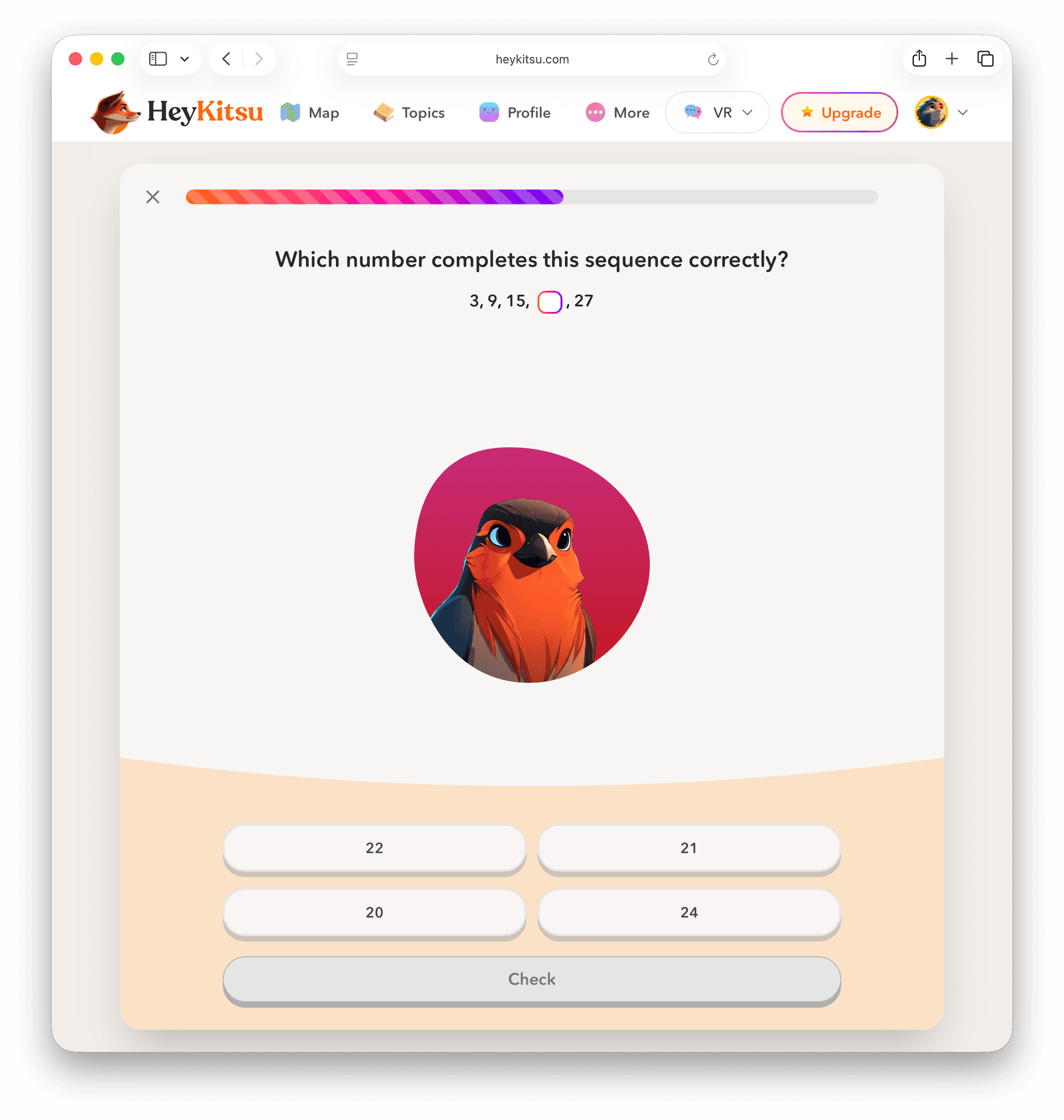
Rather than guessing, you get an actual baseline: where they're strong and where the gaps are.
You can get started for free here.
What if the answer is "not quite yet"?
Then you have time. Most children start structured 11+ preparation in Year 4 or Year 5, which gives 12 to 24 months to build the skills they need.
Collins' guidance suggests that starting earlier than Year 4 risks burning children out before they reach the exam. Two years of consistent, enjoyable preparation tends to produce better results than a frantic six-month sprint. The goal is to peak at the right moment – not to exhaust your child long before they get there.
The 11+ is learnable. Not infinitely – a child who isn't academically inclined isn't going to be transformed by tuition alone – but there's genuine skill development available through good practice. Familiarity with question types, speed, and test-taking strategies all improve with practice.
That's exactly what HeyKitsu is built to support. The platform adapts to your child's level across all four subjects, identifying weak spots and building on strengths – at a pace that suits them, on a device they actually want to use.
You can try the first three levels in every collection permanently free, with no credit card required. It's a low-pressure way to see how your child responds to the material before committing to anything.
The 11+ is a significant decision. But it's also one you can make with more information than most parents realise is available to them. Start with the data, involve your child in the conversation, and be honest with yourself about what kind of school environment they'd genuinely thrive in.

Ready for exam day?
HeyKitsu's timed practice mode builds the pacing and focus your child needs to stay calm under real 11+ conditions.
Written by
Jane CoplandConsultant and writer @ HeyKitsu
Jane is HeyKitsu's creative writing expert. A published author, she recently supported her son through the 11+, where he received an offer from his first-choice school.