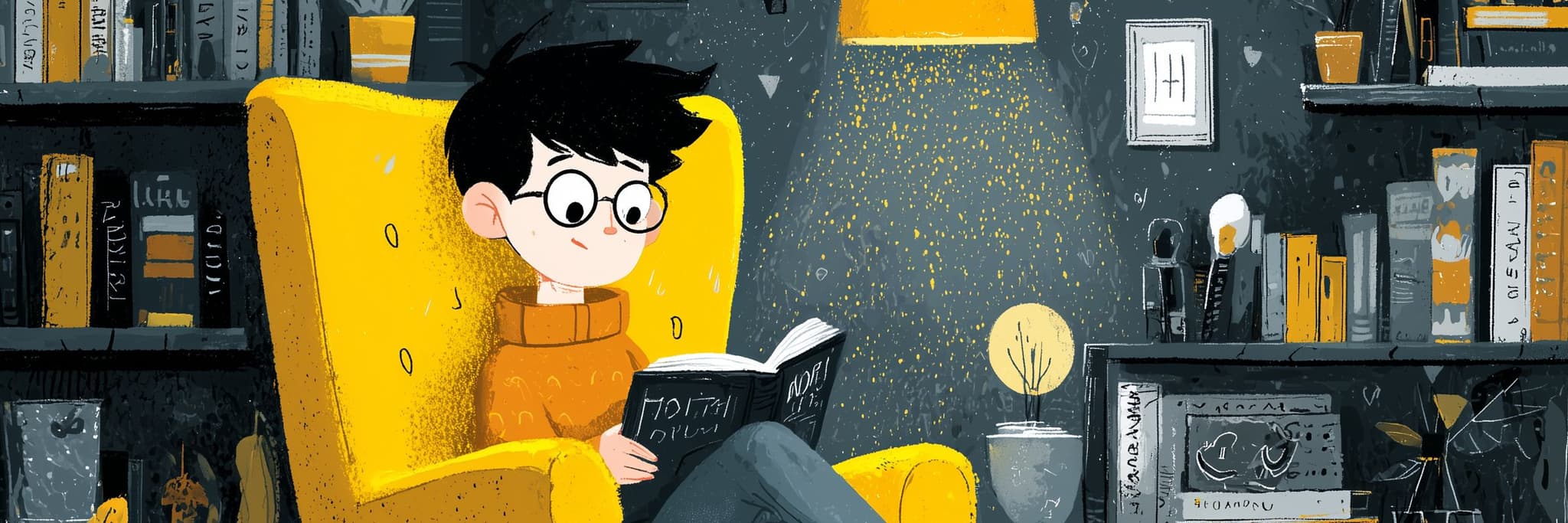
My son went through a phase of refusing to read anything that wasn't subtitles on a YouTube short. He upgraded to Minecraft fan-fiction at one point – and that felt like a solid win.
But it made me think – are some children just natural readers (like my brother)? Is there a switch that gets flicked at some point that turns people into readers (like me, much later in life)?
It turns out, the research on what reading does to a child's developing brain is striking enough that it's worth every parent knowing about.
Disclaimer: One small note – as a former resident of the town Reading, I will never not swap "reading" for "Reading", and vice versa. (This article's title – "How my son learnt to love Reading" – is a perfect example.)
Reading isn't just good for English
In 2023, researchers from Cambridge, Warwick and Fudan University published a study in Psychological Medicine that followed more than 10,000 adolescents. They found that children who started reading for pleasure early – between the ages of two and nine – showed measurably better cognitive performance, improved mental health and healthier brain structure when they reached their teens.
Not marginally better. Meaningfully better – across working memory, attention, problem-solving and emotional wellbeing. All from reading for fun.
The researchers identified around 12 hours a week as the sweet spot. Beyond that, the benefits levelled off (children still need to run around and talk to their friends). But up to that point, the more children read for pleasure, the stronger the association with brain development.
The National Literacy Trust's 2025 annual survey makes for sobering reading alongside this. Only 1 in 3 children aged 8 to 18 now say they enjoy reading in their free time – the lowest figure since the survey began in 2005. And just 1 in 5 read anything daily. Children who do enjoy reading score significantly higher on standardised reading assessments than those who don't.
The gap compounds over time. By Year 6, children who read regularly have been exposed to a volume and variety of vocabulary that children who don't read simply haven't encountered.
That matters enormously for the 11+ – not just in English comprehension, but in verbal reasoning too.
So what can you actually do?
The honest answer is that you can't force a child to enjoy reading.
But you can make it much easier for enjoyment to find them.
Rule 1: Let them read what they want
This is the most important one. The moment reading becomes something a child has to do, rather than something they choose, you've lost half the battle.
Comics, graphic novels, football annuals, joke books, wikis about video games – it all counts. The vocabulary in children's nonfiction is often richer than in many novels. What matters is that your child is reading things they're genuinely curious about.
If they're not sure what they like, take them to a library or a bookshop with no agenda. Let them wander. Let them pick something you'd never have chosen. The goal right now is a child who reaches for a book – not a child who's working through a curated reading list.
Rule 2: Read together – and ask questions
There's good neurological evidence for this one too. A study from Cincinnati Children's Hospital used fMRI scans to look at brain activity in four-year-olds during story time. Children whose parents read interactively – asking questions, inviting predictions, making it a conversation – showed significantly greater activation in the brain regions involved in comprehension and language.
The technique is sometimes called "dialogic reading". It sounds fancier than it is. You stop during the story and ask: what do you think happens next? Why do you think she did that? What would you have done?
This works for older children too. Reading the same book as your child, even if separately, and talking about it over dinner is one of the most effective reading habits a family can build. You don't need to turn it into a book club – just show genuine curiosity about what they're reading.
Rule 3: Put books where they'll be found
Children don't seek out what they can't see. Ever notice that snacks or sweets that are always in-sight tend to get eaten more often?
Books on low shelves, within easy reach in the living room or the kitchen, are more likely to get picked up than books neatly stored in a bedroom. The physical environment genuinely matters.
It's also worth having variety – different formats, different reading levels, different topics. Not a library, just a selection. The aim is that your child glances over and sees something that catches their eye.
Rule 4: Read yourself – visibly
Children copy what they see valued. If your child regularly sees you pick up a book – as a thing you actually do for yourself – it shapes how they understand reading.
If you can, don't leave it till bedtime when they're (hopefully) fast asleep. In the evenings and during the day on the weekend is perfect.
You don't need to make a thing of it. Just be visibly reading. Talk about what you're reading occasionally. Let them see that adults who have the full run of the internet still choose books sometimes.
Rule 5: Take the pressure off
One thing worth naming directly: if your child is preparing for the 11+ or ISEB, the temptation is to treat every activity as exam prep. Resist it with reading.
Reading for pleasure works because it's pleasurable. The cognitive benefits – vocabulary, comprehension, reasoning – accumulate quietly over time, precisely because the child isn't thinking about accumulating them. The moment reading becomes associated with performance and pressure, many children pull back.
The goal is a child who reads because they want to. Everything else follows from that.
At HeyKitsu, we're pretty careful about not adding to the pressure children already feel.
Our app is designed to feel like a game – not a test session. If you want to see how we approach 11+ and ISEB prep, the first few levels in every collection are permanently free, no sign-up required.
Stephen ❤️

Your child's 11+ coach, on demand
Fun, game-like practice that adapts to your child's pace. No more nagging.